


Church of Panagia Galoktisti, Pyrgos Tillyrias, Cyprus
The Church of Panagia Galoktisti is located between the communities of Pano and Kato Pyrgos in Tillyria (Nicosia District). The epithet *Galoktisti* refers to the tradition surrounding the construction of the church. According to local tradition, in order to ensure the stability of the building, the mortar was mixed with milk from the flocks of the area instead of water. Even today, the church is sprinkled with milk, whether animal or human, as part of a traditional practice associated with the healing of existing ailments.
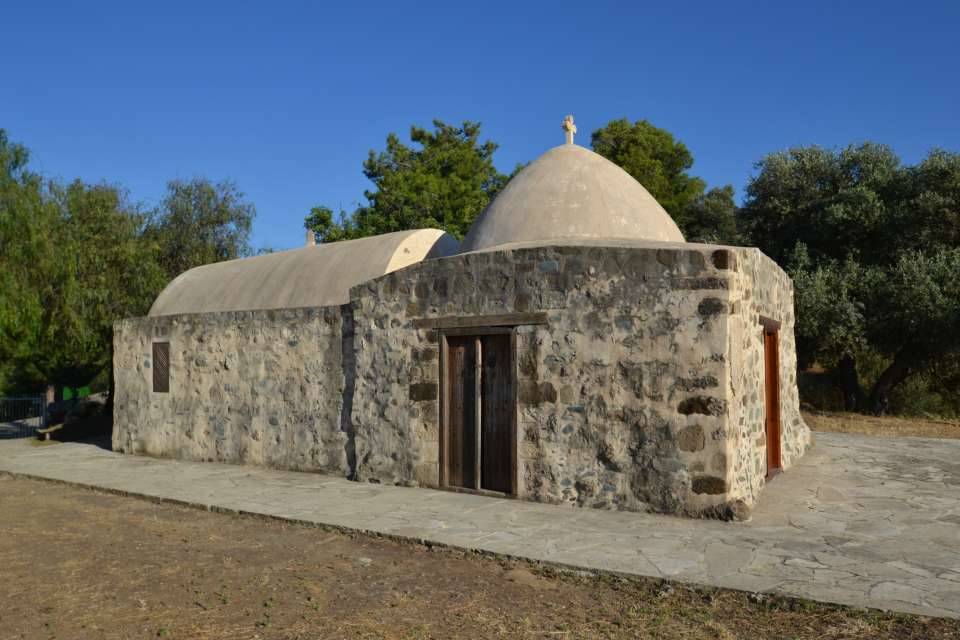
Architecturally, the church consists of two building phases. The main church is small in size, single-aisled and barrel-vaulted. A square narthex was later added to its western side, covered by a domical vault, a characteristic feature of a number of monuments dating from the Middle Byzantine period in Cyprus. Local volcanic stone, sandstone and pebbles from the nearby river were used as building materials. Lime mortar was used as a binding material and appears originally to have covered the exterior wall surfaces as well, which were decorated with red-painted geometric motifs. Traces of this decoration survive on the western exterior wall of the narthex. The roof is covered with hydraulic mortar, while the floor is paved with pebbles. The church has two rectangular entrances into the narthex, on the northern and western walls, and a small window in the apse of the sanctuary. The church was once entirely covered with wall paintings. Two successive layers have been identified, although both have suffered extensive deterioration. Reconstructing the church’s iconographic programme is therefore difficult. No complete scene survives from the earliest layer. In the apse of the sanctuary, Saint Auxibios survives among the concelebrating hierarchs, while Saints Constantine and Helen are depicted on the northern wall of the main church. Part of the scene of the Nativity of Christ survives on the domical vault. An unidentified saint is preserved on the northern wall of the narthex, while Saint John the Baptist is depicted on the pier of the northern pendentive, where he formed part of a Deesis scene. On the southern wall there was also a figure of an Archangel.
Based on architectural and stylistic evidence, the main church is dated to the 11th century, while the narthex and the second phase of wall painting are assigned to the 12th century.
Of particular significance is the church’s large devotional icon, depicting the Virgin and Child in the type of the Kykkotissa, which is dated to the late 13th century.
Bibliography:
Σολομίδου Ιερωνυμίδου Μαρίνα, «Εργασίες συντήρησης και αποκατάστασης σε εκκλησιαστικά μνημεία της μητροπολιτικής περιφέρειας Μόρφου, που αναλήφθησαν από το Τμήμα Αρχαιοτήτων κατά την περίοδο 1998 -2000», Ιερά Μητρόπολις Μόρφου 2000 χρόνια τέχνης και αγιότητος, Λευκωσία 2000, σσ. 203 -204.
Georgios Philotheou, “The Church of Panagia Galoktisti at Pyrgos Tillyrias”, *Proceedings of the Conference: Tillyria – Memories, History and Archaeology*, Nicosia 2010, pp. 97–120.