


The establishment and operation of the Museum of the Holy Monastery of Kykkos, distinguished in every respect, would have been incomplete had this scientific institution not also been supported by the creation of art conservation laboratories. The project was completed rapidly in 1999. Thus, near Nicosia, at Archangelos, the former agricultural dependency of the Holy Monastery of Kykkos, the Conservation Laboratories of the Museum of the Holy Monastery of Kykkos are now housed in a separate building, forming the unseen heart behind the Museum’s exhibition spaces.
The laboratories are housed in a modern building covering 1,200 square metres, designed and constructed from the outset specifically for laboratory use.
Its spacious and secure facilities accommodate five specialised conservation departments:
- Icons
- Paper
- Textiles
- Wood
- Metals
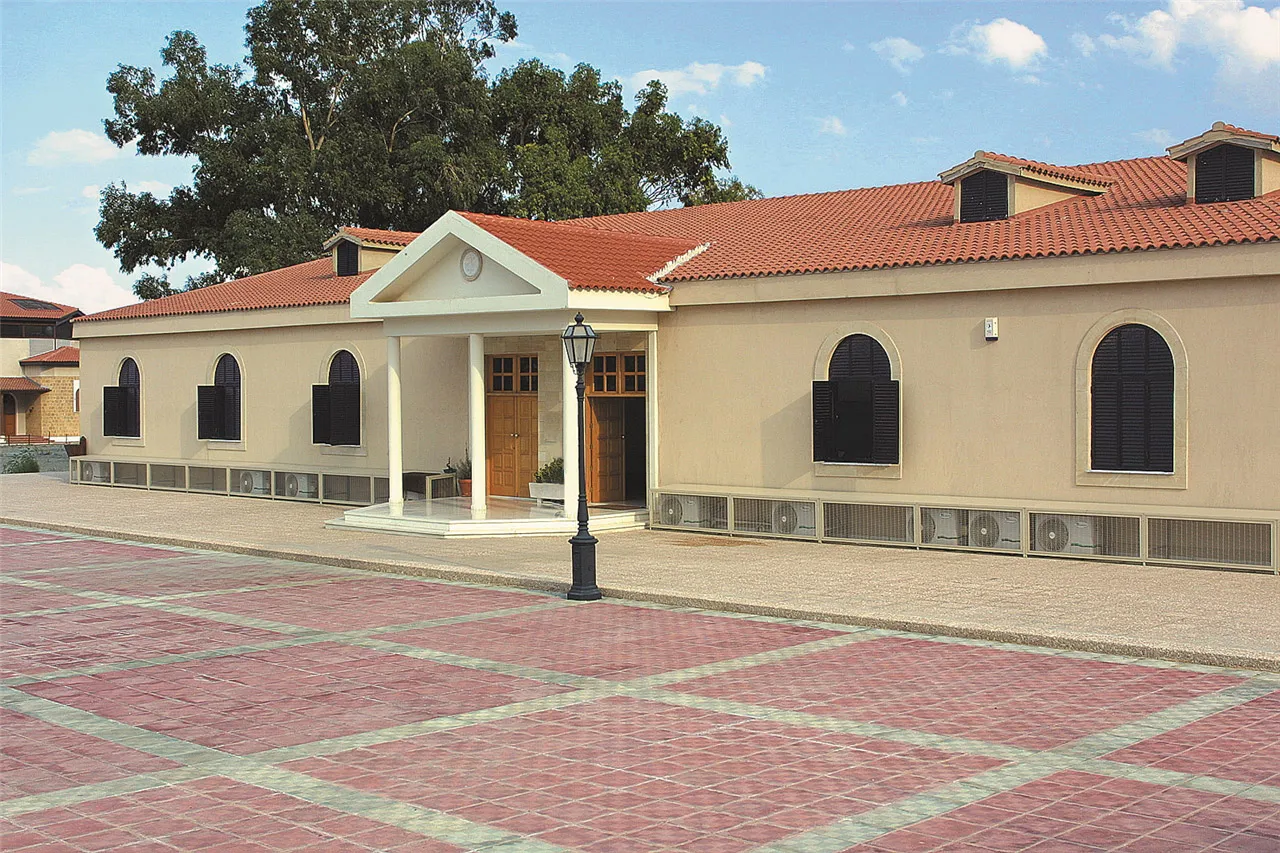
Essential supporting facilities include the Photographic Laboratory, used for the visual documentation of the various stages in the conservation of each object; the Collections Archive and Index; the administrative office; storage areas; and communal facilities.
State-of-the-art equipment and tools, specially imported from European countries, fill the spacious laboratories and assist the staff in carrying out their work to the highest possible standard. These include a nitrogen anoxic disinfestation system, stereomicroscope, suction table, vacuum equipment, precision digital kilns, an optoelectronic laser system, pantograph, presses, distillation equipment, humidification systems and other specialised apparatus. What truly brings the laboratories to life, however, is their staff, who devote countless hours, with great care and dedication, to the works of art entrusted to them, helping to preserve them for the future against the effects of time.
The team consists of fourteen members, most of whom are young professionals with distinguished studies at institutions and universities in Europe and the United States, including Greece, Italy, the United Kingdom and the United States of America. In addition to conservation, their academic backgrounds extend to history, archaeology and art history. Some pursued their studies with scholarships awarded by the Holy Monastery of Kykkos.
The continuous professional development of the staff and their awareness of the latest scientific advances are among the Museum’s principal priorities. Regular specialist training, participation in specialised conferences, membership of international organisations and subscriptions to scientific conservation journals all contribute to the continuing development and advancement of the team.The continuous professional development of the staff and their awareness of the latest scientific advances are among the Museum’s principal priorities. Regular specialist training, participation in specialised conferences, membership of international organisations and subscriptions to scientific conservation journals all contribute to the continuing development and advancement of the team. When circumstances require it, temporary staff reinforce the existing team. This was the case during the conservation of the ruined 16th-century Monastery of Panagia tou Sinti in Paphos, a dependency of the Monastery of Kykkos, which received a Europa Nostra award in recognition of the success of its conservation.
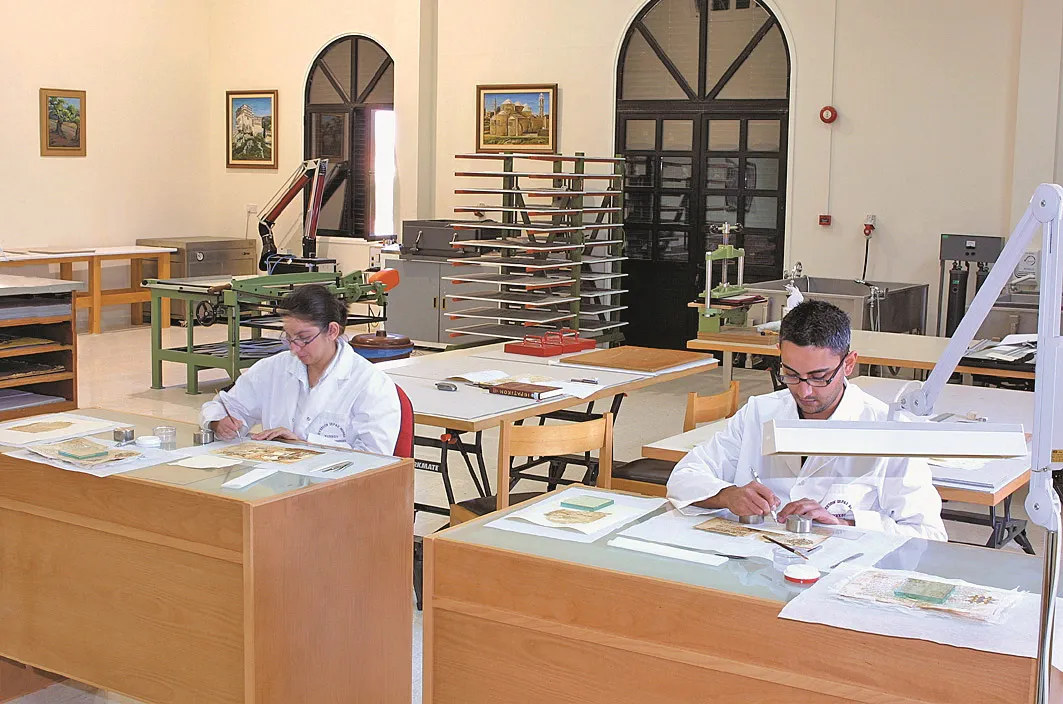
A fundamental principle governing all departments of the laboratories is that intervention on objects undergoing conservation should be kept to the minimum necessary, so that their authentic character is not altered. The materials used are, wherever possible, reversible. From the moment an object enters the laboratory until its conservation treatment is completed, every stage is accompanied by detailed written and photographic documentation. This information is subsequently entered into digital records so that it may remain available at all times to researchers and future conservators.
During the course of conservation work, when specialised analyses are required to resolve particular problems and cannot be carried out within the Museum’s own facilities, samples or materials are sent to laboratories abroad. As a non-profit organisation, the Conservation Laboratories of the Kykkos Museum not only conserve the wide range of works of art belonging to the Monastery of Kykkos, but also undertake the conservation, at favourable rates, of objects belonging to public and semi-governmental organisations, the Archbishopric, the Metropolises, village churches and private individuals. The establishment of modern art conservation laboratories was an urgent need for Cyprus.
The establishment of modern art conservation laboratories was an urgent need for Cyprus. Although the responsibility for meeting that need might have rested with other institutions, once again the Church filled the gap through the venerable Holy Royal and Stavropegic Monastery of Our Lady of Kykkos, with its more than 900 years of history, sparing neither effort nor expense. This undertaking opened new and pioneering paths for the preservation of the cultural treasures of the long-suffering island of Cyprus. In recognition of his contribution to culture, the Mayor of Athens recently honoured the Abbot of the Monastery, Nikephoros — now Metropolitan of Kykkos and Tillyria — with the Gold Medal of the City of Athens.